
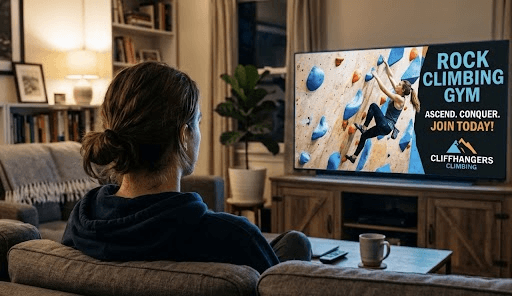
For decades, small business owners operated under a persistent myth: Television advertising is only for Fortune 500 companies with multi-million-dollar budgets. Today, with the rise of streaming platforms, regional broadcasting, Connected TV in general, television has become one of the most accessible and high-ROI channels for local and mid-sized businesses.
However, launching a TV campaign involves more than simply producing a sleek 15-second commercial and airing it once. The true power of television advertising lies in Effective Frequency—the science of how many times a target viewer must see an advertisement before they remember the brand and take action.
If you want your small business to stand out in a noisy market, here is why TV remains an unbeatable medium and what psychological research reveals about frequency and human action.
The Power of TV for Small Businesses
While digital channels like search and social media have their place, television offers distinct advantages that small businesses often overlook:
- Instant Credibility and Prestige: Consumers naturally associate TV appearances with established, trustworthy brands. Appearing on the same screen as national brands immediately elevates local business authority.
- High-Impact Storytelling: Sight, sound, and motion combine to evoke emotion and communicate complex value propositions far faster than static web banners or text ads.
- Hyper-Targeted Local Reach: Modern TV advertising (especially Streaming TV/CTV) allows small businesses to target specific cities, demographics, household income levels, and viewing habits, eliminating wasted ad spend.
- Undivided Attention: Unlike mobile ads that users rapidly scroll past, TV viewers engage with content on larger screens, resulting in significantly higher video completion and ad recall rates.
How Many Times Does a Viewer Need to See Your Ad?
The pivotal question behind every successful media strategy is: How many exposures does it take to convert a prospect into a customer?
Marketing scientists and behavioral psychologists have studied this phenomenon for over a century. The consensus is clear: One exposure is virtually never enough.
1. The Rule of 7 (Marketing Researcher's Golden Standard)
One of the oldest and most widely cited concepts in advertising is the Rule of 7, originally formulated in the early 20th century. It states that a potential customer needs to see or hear a marketing message at least seven times before they will make a purchasing decision.
Why seven? Human memory relies on repetition to move information from short-term memory into long-term retention. In a world where the average consumer is exposed to thousands of commercial messages daily, it takes multiple touchpoints to break through cognitive noise.
2. Krugman’s "Three-Hit Theory"
In the 1970s, Herbert E. Krugman, a researcher at General Electric, introduced the Three-Hit Theory of advertising, which broke down the psychology of viewer exposure into three distinct stages:
- Exposure 1: "What is it?" The viewer first perceives the ad. Their focus is purely cognitive identifying what the product or service is.
- Exposure 2: "What of it?" The viewer recognizes the brand and begins processing the message. They evaluate whether the offering is relevant or useful to their lives.
- Exposure 3: "The Reminder / Action Trigger." The third exposure serves as a prompt. If the need exists, the viewer is ready to act.
While Krugman argued that three conscious, attentive exposures are the minimum threshold for action, reaching three attentive views in the real world often requires 6 to 10 actual ad exposures to account for viewer distraction.
3. Thomas Smith’s Classic Frequency Scale
In 1885, London businessman Thomas Smith published Successful Advertising, outlining a humorous yet remarkably accurate 20-step guide on how repetition alters consumer psychology:
- 1st time: They don’t even see it.
- 3rd time: They are aware that it is there.
- 5th time: They actually read it.
- 10th time: They ask their friends or neighbors if they’ve tried it.
- 12th time: They start to think it must be a good product.
- 15th time: They begin to yearn for it.
- 20th time: They finally make the purchase.
While modern consumer habits move faster, Smith’s core premise remains valid: repetition transforms unfamiliarity into trust, and trust drives conversion.
4. Modern Science: The "Mere Exposure Effect"
Psychologists refer to this behavior as the Mere Exposure Effect (first detailed by Robert Zajonc). The principle demonstrates that people naturally develop a preference for things simply because they are familiar with them.
When a local homeowner’s air conditioner breaks or they need a reliable lawyer, they rarely pick a random search result. They choose the brand that feels familiar—and nothing builds familiarity faster or more authoritatively than repeated TV spots.
Building an Effective TV Strategy for Your Small Business
Understanding frequency is the key to maximizing your advertising budget. Spreading a small budget too thin across a massive audience results in low frequency, meaning viewers won't see your ad enough times to remember it.
Key Takeaways for Small Business TV Campaigns:
- Prioritize Frequency Over Broad Reach: It is far better to reach 10,000 local prospects 7 times than to reach 70,000 prospects just once.
- Maintain Consistency: Ad exposure needs to be spread out consistently over time to build steady retention without overwhelming the audience.
- Combine TV with Digital Tracking: Use TV to build high-trust brand awareness and couple it with clear calls-to-action (custom URLs, QR codes, or phone numbers) to measure response rates.
Ready to Elevate Your Business with Television?
Television advertising is no longer reserved for national conglomerates and big box stores. With smart targeting and an intentional frequency strategy, small businesses can dominate local markets, build lasting trust, and drive consistent customer growth.
At Argon Ads, we specialize in helping growing businesses design, produce, and place high-impact TV campaigns tailored to your specific market and budget.
Contact Argon Ads today to discover how accessible and effective television advertising can be for your business!